
What Is the NUST Entry Test?
The NUST Entry Test (NET) is the admission test for students applying to NUST undergraduate programs. It's based on SSC and HSSC level concepts, contains MCQs only, and must be solved within a limited time.
NET is not about memorizing formulas. It checks how well you understand a topic and how quickly you can apply that concept in an MCQ. That's why a student who practices regularly will always outperform one who only reads theory.
Current NET Pattern (Engineering)
The current NET for Engineering/Computing consists of Mathematics (50%), Physics (30%), and English (20%). Chemistry and Intelligence sections have been removed from the recent NET format.
The Merit Formula — Know the Math
Your NUST admission isn't based on NET alone. Here's how the merit is calculated:
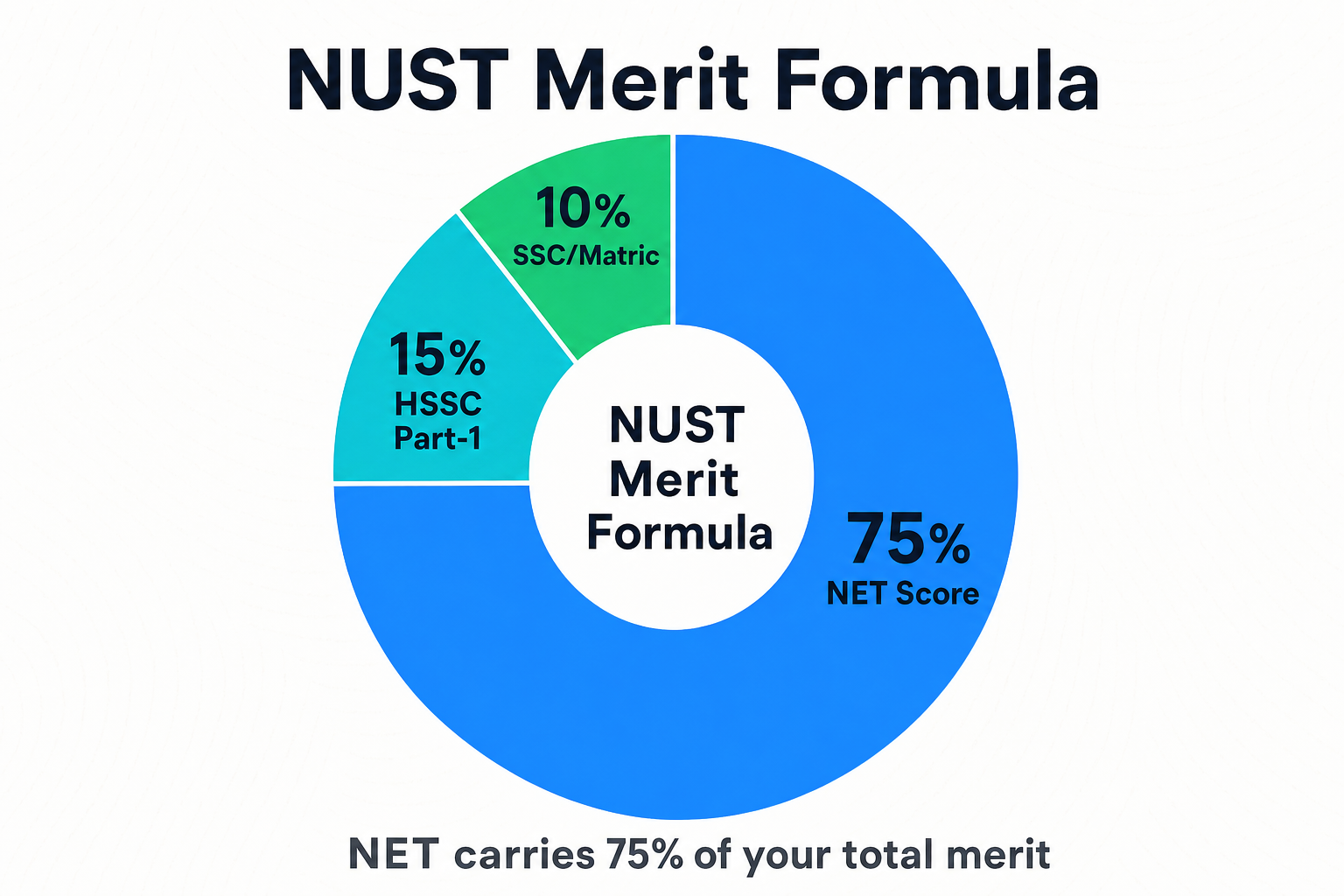
General Merit Formula (NET Basis)
What this means: NET carries 75% of your total merit. Even if your Matric and FSc scores are average, a high NET score can still get you in. Conversely, no amount of board marks can compensate for a weak NET score. NET is where the battle is won.
Don't Skip First Year or Second Year
One of the biggest mistakes students make is believing NET mostly comes from first-year or mostly from second-year books. This is not a safe approach.
NET can test concepts from both years, and sometimes a question connects more than one concept. If you want maximum marks, do not take shortcuts in syllabus coverage.
Strong Concepts Are the First Step
Before solving hundreds of MCQs, first make your concepts strong. In Maths and Physics, the question is often short but needs quick thinking. If your concept is weak, you'll waste time figuring out which formula to apply.
Key Maths Topics
Key Physics Topics
Don't just memorize formulas — understand where they are used. NET often tests the application of a formula, not just the formula itself. Also read the small text boxes in your Physics textbook — they often become MCQs.
Subject-Wise Strategy
Mathematics — 50% Weight
Deciding SubjectMathematics is the deciding section. Focus on understanding formulas and shortcuts rather than solving long derivations. The key is speed through recognition — when you've seen enough MCQ patterns, you instantly know the approach.
High-priority chapters: Integration, Conic Sections, Matrices, Trigonometry, Differentiation, Sequences & Series, Complex Numbers. Expect 7–10 MCQs from Conics alone.
Physics — 30% Weight
Physics is heavily formula-based. Most MCQs can be solved with one or two formulas. Memorize all formulas until they're at your fingertips. Read the small text boxes in your FSc books — they often become tricky MCQs.
Key areas: Mechanics, Electricity & Magnetism, Waves, Thermodynamics, Modern Physics, Electronics, Optics. Practice unit conversion and dimensional analysis.
English — 20% Weight
Many students ignore English because they think it's simple. This is a mistake. English can help you gain extra marks if you prepare it properly. Just 20–30 minutes daily makes a difference.
Why Practice Is the Main Key
Maths and Physics decide the final score. They need more practice because they are calculation-based and concept-based. In NET, you don't have time to solve every question slowly — you need speed, and speed comes from practice.
When you practice MCQs daily, you start recognizing question patterns. You understand which formula is needed. You learn which questions take more time and which can be solved quickly.
Your practice should include:
Memorize Important Formulas
Calculators are not allowed in NET. This means you must be mentally prepared for quick calculations. Make a formula notebook — write important formulas chapter-wise and revise them daily.
Your formula notebook should include:
Short tricks for trig values, integration, differentiation, and option elimination are very useful — but they only work when your concept is already clear. First understand the concept. Then learn the shortcut.
Past Paper Strategy
NUST doesn't provide full official past papers. Most available questions are based on student memory and repeated patterns. Still, they're extremely helpful because they show you the type of thinking needed.
When using past paper style questions, don't just memorize answers. Ask yourself:
Which concept is being tested here?
Why is this formula applied?
Can this question be solved faster?
What mistake could I make here?
Is there a shortcut?
Resource tip: Focus on self-study using your FSc textbooks (Punjab Textbook Board recommended). Practice books like KIPS or STEP are widely recommended by previous test-takers. Avoid falling into the trap of endless paid online courses.
Time Management Is the Main Key
NET is not only a knowledge test — it's a time management test. You have roughly under a minute per MCQ. Many students know the answer but lose marks because they spend too much time on one question.
The Winning Strategy:
Solve easy questions first — build confidence and bank marks early.
Skip lengthy questions in the first round — come back to them later.
Don't spend more than 60 seconds on any single MCQ.
Keep the last 10 minutes for review and rechecking skipped questions.
Attempt all questions — there's no negative marking in NET.
Eliminate wrong options first, then choose the best possible answer.
Daily Study Routine
A simple, consistent daily routine beats cramming sessions every time. Here's a practical routine:
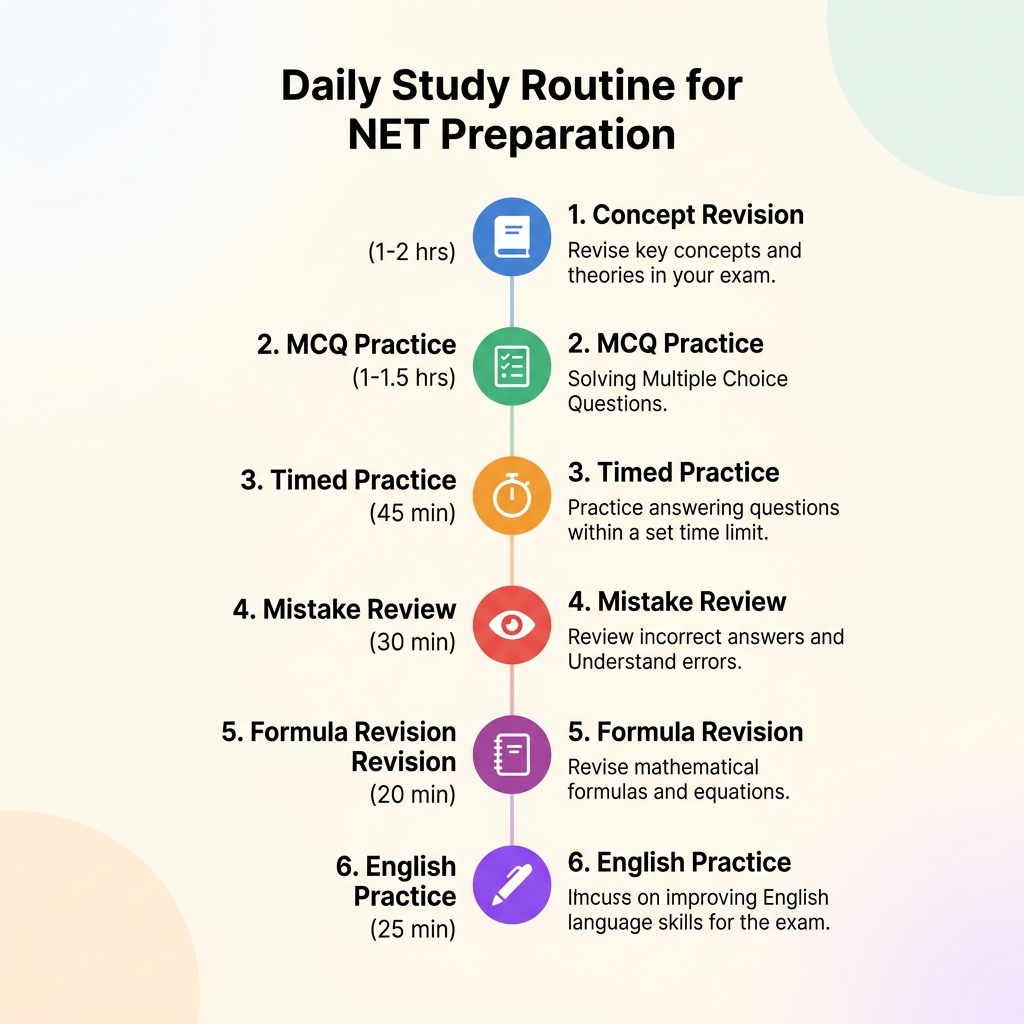
Concept Revision
1–2 hrsSpend 1–2 hours revising Maths or Physics concepts from your textbook.
MCQ Practice
1–1.5 hrsSolve chapter-wise MCQs from the topic you studied. Start easy, move to advanced.
Timed Practice
45 minGive yourself a fixed time limit and solve a set of mixed MCQs under pressure.
Mistake Review
30 minCheck every wrong answer. Write the reason for each mistake. This is the most important step.
Formula Revision
15–20 minRevise formulas from your notebook. Do this daily — don't wait for the last week.
English Practice
20–30 minPractice vocabulary, grammar, or comprehension. Small daily effort adds up.
Common Mistakes to Avoid
Many students work hard but still don't score well because their method is weak. Avoid these pitfalls:
Only Watching Lectures
Watching lectures is not enough. You must solve MCQs yourself.
Ignoring Second Year
Don't assume only first-year topics will come. Prepare both years fully.
Weak Formula Revision
If you forget formulas during the test, you will lose time and marks.
No Timed Practice
Solving MCQs without time pressure is not enough. NET is time-based.
Not Reviewing Mistakes
Wrong answers are your best teacher. Review them properly every day.
Ignoring English
English marks can improve your final score significantly. Don't skip it.
Random Guessing Too Early
First eliminate wrong options. Then choose the best answer.
Exam Day Strategy
On exam day, stay calm and follow a simple plan. Don't panic if the first few questions look difficult — this happens with many students. Move to questions you can solve quickly.
Your Exam Day Checklist
Read each question carefully — don't rush the reading.
Solve easy MCQs first to build momentum.
Skip time-consuming questions for the first pass.
Use elimination where possible.
Keep checking your remaining time.
Leave at least 10 minutes for final review.
Attempt ALL questions before time ends — no negative marking!
Confidence matters, but overconfidence is dangerous. Stay focused till the last minute.
Take Multiple Attempts
NUST considers your best score across all series. This is a huge advantage. Use your first attempt to experience the actual interface and pressure, then spend time addressing weak areas before the next series.
What experienced students say:
Most students score well after 2–3 attempts. Getting 165+ in just one attempt is very rare. The key is to start early, identify weaknesses after each attempt, and improve consistently. There are 4 NET series for a reason — use them strategically.
Aiming for 150–165+ is the safety zone for securing admissions in highly competitive programs like Computer Science and Engineering.
Frequently Asked Questions
How can I get maximum marks in NET?
Prepare both first-year and second-year concepts, practice MCQs daily, revise formulas, solve timed tests, and review your mistakes. Consistency beats cramming.
Is NET mostly from first year or second year?
You should prepare both. Don't depend on fixed percentage assumptions — the test can include concepts from both parts, sometimes combined.
Are past papers enough for NET preparation?
Past paper style questions are helpful, but not enough alone. You should also study concepts from textbooks, solve chapter-wise MCQs, and practice timed tests.
Is a calculator allowed in NUST Entry Test?
No, calculators and electronic gadgets are not allowed. That's why you should practice mental calculation and memorize important formulas.
How important is time management in NET?
Extremely important. Many students lose marks because they spend too much time on difficult questions. Solve easy questions first and keep time for review.
Should I prepare English for NET?
Yes, English carries 20% weight. Practice vocabulary, grammar, sentence correction, and reading comprehension to improve your score.
What score should I aim for in NET?
For competitive programs like Engineering and CS, aim for 150–165+. Your NET score is 75% of your total merit, so it's the most impactful component.
Getting maximum marks in NET is possible if your preparation is focused. Strong concepts, regular MCQ practice, formula revision, and good time management. Start with the basics, build up, practice daily, review mistakes, and improve your speed. That's the real way to score high. 🎓